


HT-PEM fuel cell performance is critically dependent on the full utilization of the cell active area of each single cell within the entire stack arrangement. The cell performance itself is governed by the local availability of hydrogen and air transported from the gas supply channels across the GDL towards the catalyst layers on the anode and cathode sides. On stack level, hydrogen and air supply to the individual cells is strongly determined by the flow distribution in the inlet manifolds and can considerably vary along the stack height. The differences in fuel and air supply not only result in performance variations along the individual cells in the stack but exert an even more critical impact on the various degradation processes determining stack lifetime. Accordingly, determination of the performance and degradation characteristics of entire stacks requires a comprehensive modelling and simulation approach, capable of reflecting the impact of hydrogen and air concentration inhomogeneities among the different cells in the stack on its overall performance and degradation characteristics.
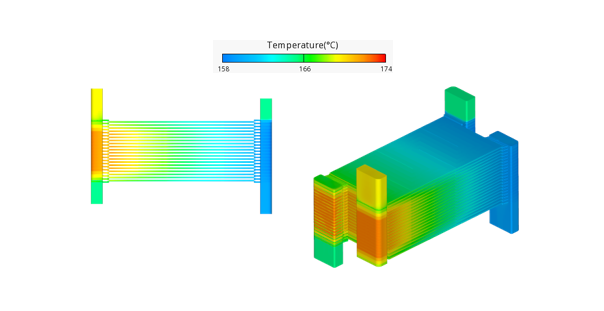
3D short-stack model built from 20 single-cells; cathode channel temperature (left), bipolar-plate temperature (right)
For this purpose, the HT-PEM fuel cell model of AVL FIRE™ M was extended towards a spatially resolved representation of the catalyst layer adopting an agglomerate approach to represent the coupled transport of heat, mass, charge and electrochemical reactions. Validation of the novel model was achieved by simulation of the performance characteristics of laboratory-scale unit-cells and comparison of the U-I characteristics with the experimentally obtained data provided by the project partners TU-Graz and ADVENT. Besides the integral polarization behavior, the application of the extended model provides detailed insight into cell-internal thermal, species transport and electrochemical conversion processes during quasi-stationary and dynamic operation which are usually very difficult or even impossible to measure.
To analyze and assess the impact of hydrogen and air supply characteristics on stack level, i.e. to identify and quantify potential media supply cell-to-cell variations, a simulation methodology was elaborated for fast and easy stack model generation based on single unit-cell models. Based on this methodology the hydrogen and air mass-flow rates and hence the related impact on individual cell performance and thermal characteristics can be analyzed virtually early in the development process without the need for a full stack hardware prototype.
